Founder Compass: Designing a Privacy-First Entrepreneurial Profiler for DACH Founders
Most founders fail not from lack of ideas, but from a mismatch between their profile and their business model. Here is how I built a tool to address that.

In this Article
- The Real Reason Most Founders Struggle
- Where I Stand
- Why Existing Tools Miss the Point
- What I Built — and Why
- How It Works
- Who Should Use It
- Tools and Consulting: Two Sides of the Same Work
- A Final Note
Executive Summary
- Most founders fail not from lack of ideas, but from a fundamental mismatch between their psychological profile, risk tolerance, and the business model they are trying to build
- Existing “founder readiness” tools — personality quizzes, generic AI prompts, one-size-fits-all frameworks — do not address this mismatch; they describe the user, they do not challenge their assumptions
- I built Founder Compass: a 12-question AI profiler that maps behavioral and financial constraints to a structured founder report, streamed in real time via a stateless Cloudflare Worker — no database, no user accounts, GDPR-compliant by architecture
- The tool is part of a broader approach: building real instruments to test ideas, then offering consulting to make them work in practice
The Real Reason Most Founders Struggle
Most founders do not fail because they lack ambition, market knowledge, or technical skills.
They fail because they choose a business model that is structurally incompatible with who they are.
A person who genuinely needs financial security within three months cannot bootstrap a product business that takes 18 months to reach profitability. A solo operator who works best with deep focus cannot build a business that requires constant client management and relationship selling. These are not motivational problems. They are alignment problems.
The mismatch tends to show up late — after the savings are spent, after the first customers are acquired at the wrong margin, after the founder realizes the model they chose requires skills, time, or risk tolerance they do not actually have.
Catching it earlier changes the outcome.
Where I Stand
I work in German finance. Accounting, financial reporting, DACH regulatory environments — this is the professional context I operate in daily.
Alongside that work, I build tools for founders and finance professionals: a startup runway calculator, an XRechnung generator for German e-invoicing compliance, and now a founder profiler.
The pattern I observe repeatedly is not a lack of information. Founders have access to more frameworks, content, and advice than at any previous point. The gap is structural: most advice is generic by necessity, because it does not know enough about the specific person to be useful.
I build tools that try to close that gap.
Why Existing Tools Miss the Point
Startup personality quizzes tell you what type you are. They rarely tell you whether your type is compatible with the business you are about to build.
Generic AI tools like ChatGPT produce generic output — because they receive generic input. Without a structured intake that forces the user to articulate real constraints, the output defaults to frameworks that fit everyone and therefore help no one.
Most mentor advice is calibrated for VC-track startups: scalability, product-market fit, fundraising. This is useful for a narrow segment of founders. For the freelancer thinking about productizing her practice, the mid-career professional building a side business, or the specialist consultant evaluating whether to go independent — it is largely irrelevant.
Founders do not need more motivation. They need alignment.
A structured analysis of what their profile actually implies — financially, operationally, psychologically — is more useful than a motivational framework. The honest answer to “should I build this?” is almost never yes or no. It is “not with this model, given your constraints.”
What I Built — and Why
So I built Founder Compass to answer one question:
What business model actually fits the person building it?
The tool is not a personality quiz. It is a structured intake that maps concrete constraints — financial runway tolerance, preferred work style, market entry preference, risk appetite, definition of success — to a founder profile built by an AI model trained to give specific, non-hedged recommendations.
The output is intentionally structured to challenge assumptions. It does not validate what you already believe. It identifies the model that fits your actual constraints, including the one you may not have considered.
The architecture behind it reflects the same values as the output: no data stored on any server, no user accounts, no tracking. The report lives in your browser. The only data that leaves your machine is the 12 answers you submit, transmitted once, processed once, discarded immediately after.
Privacy-first is not a marketing position here. It is an architectural constraint enforced at the infrastructure level.
┌──────────────────────────────────────────────────────────────┐
│  Browser (Svelte 5 island, client:visible)                   │
│                                                              │
│  FounderCompassApp                                           │
│   ├── phase: 'quiz' | 'consent' | 'report'  ($derived)       │
│   ├── answers[12]                           ($state)         │
│   ├── lastGeneratedAt: number | null        ($state)         │
│   └── weeklyLocked: boolean                 ($derived)       │
│                                                              │
│  localStorage: quiz progress + completed report              │
│  (never leaves the browser)                                  │
└───────────────────────────┬──────────────────────────────────┘
                            │ POST /api/compass
                            │ { answers: [12 × {dimension, selectedKey, label}] }
                            │ transmitted once · processed once · discarded
                            │
┌───────────────────────────▼──────────────────────────────────┐
│  Cloudflare Worker: /api/compass                             │
│                                                              │
│  1. Hash client IP → SHA-256 hex (non-reversible)           │
│  2. Check Cache API for quota key (TTL: 604,800s / 7 days)  │
│  3. Build structured prompt from 12 answers                  │
│  4. Stream o4-mini response via SSE (event: delta)          │
│  5. Set Cache API quota key on success                       │
│                                                              │
│  No database · No user table · No stored answers            │
└──────────────────────────────────────────────────────────────┘
Current-state note: /api/compass streamed via OpenAI’s o4-mini model at the time this article
was written. Production has since migrated to the Responses API (/v1/responses) on the
gpt-5.6-sol model tier; the streaming, quota, and no-storage architecture described above is
unchanged. See the AI Responses migration record
for the current provider contract.
How It Works
The profiler asks 12 questions structured around behavioral economics logic and financial reasoning.
Each question targets a specific founder dimension: risk tolerance, runway comfort, founding motivation, team preference, business model orientation, market entry strategy, financing approach, operational resilience, work-life boundaries, technical capability, industry focus, and definition of success.
Every question offers four predefined options covering the realistic range of positions, plus a free-text option for founders whose situation does not map cleanly to any of them.
The answers are submitted once to an AI endpoint. The model produces a structured analysis — not a list of possibilities, not a probability distribution, but a direct assessment of what fits and what does not.
The output is intentionally structured to challenge assumptions rather than confirm them.
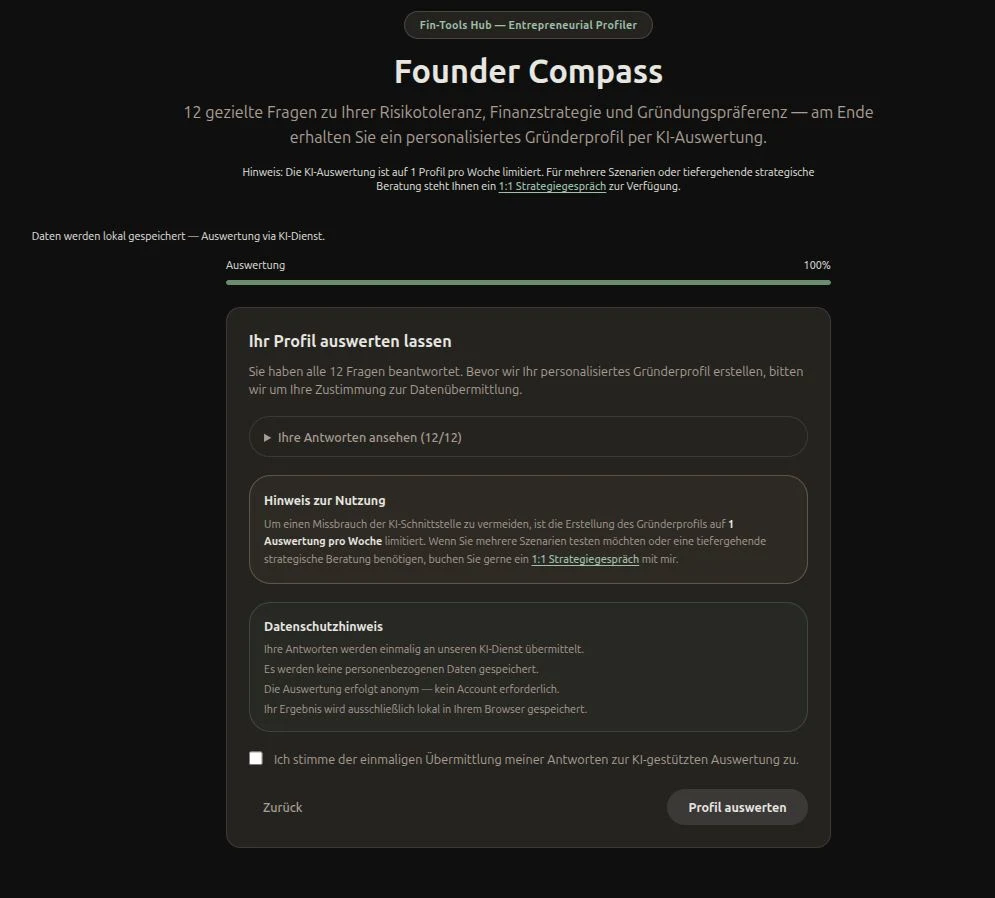
There are no screenshots here, no preview of the report format. The experience of receiving a founder profile that is specific to your constraints is worth arriving at without prior context.
Who Should Use It
Founder Compass is built for three specific situations:
People building side-projects on evenings and weekends. You have a stable income and you are testing whether a business idea is worth pursuing seriously. Before you invest a year of evenings, it is worth knowing whether the model you are considering fits how you actually work and what you actually need financially.
Freelancers thinking about scaling. You have clients, you have a service, and you are evaluating whether to productize, hire, or expand. These are structurally different decisions with different implications for your risk profile. The profiler maps which path is compatible with your constraints.
Founders unsure about the right business model. You know the domain, you know the problem, but you are not certain whether the model should be consulting, SaaS, marketplace, or something else. Founder Compass is built to force a concrete recommendation, not a framework for you to apply yourself.
If you already have a clear model, validated revenue, and operational momentum — this tool is not for you. It is for the earlier stage, when the decision of what to build and how to build it is still open.
Tools and Consulting: Two Sides of the Same Work
I build tools to test ideas.
I offer consulting to make them work in reality.
These are not separate activities. The tools I build are informed by the structural problems I encounter in consulting engagements. The consulting work I do is grounded in the same analytical frameworks the tools encode.
Founder Compass is a direct product of observing the same mismatch problem across multiple engagements: founders in the DACH region, technically or financially competent, who chose a business model that was structurally incompatible with their real constraints.
A tool that runs an AI-powered intake cannot replace a structured consulting conversation. It can, however, surface the right questions earlier — before the decision is made, not after the consequences are visible.
If the profiler identifies a tension you want to explore further, the next step is a 1:1 strategy session. That is where the tool ends and the work begins.
A Final Note
If you are building something on evenings and weekends — alongside a job, family, or other obligations — the cost of moving in the wrong direction for six months is not just financial. It is the opportunity cost of time you cannot get back.
Founder Compass might not give you the answer you expected. That is by design.
Try it: me-mateescu.de/tools/founder-compass